
HubSpot Customer Agent: Design the Human Handover Before Launch

An AI customer agent needs a reliable way to stop, ask for help and transfer responsibility. Before launching a HubSpot Customer Agent, define the questions it may answer, the information it may use and the situations a person must handle. A fluent conversation is not enough if a customer cannot reach the right team.
The handover is part of the customer journey. It should preserve useful context and explain the next step without promising a response that the business cannot deliver. Plan it alongside your knowledge sources and service ownership, not after the first complaint.
Define a bounded job for the agent
Start with a narrow set of tasks such as explaining public services, helping visitors find an approved resource or collecting the information a team needs to respond. Separate those tasks from decisions involving exceptions, disputes or information the agent cannot verify.
Create a source inventory. For each page or document, name its owner, audience and review responsibility. Remove contradictions and avoid exposing internal instructions or customer-specific data through public sources.
Our published dynamic-knowledge customer-agent project provides a related implementation context. The general lesson is to make knowledge intentional: an agent should not be expected to resolve an unclear policy by guessing which source is authoritative.
Decide when the conversation must leave AI
HubSpot's human-handoff documentation describes default transfers and configurable guidelines. It also distinguishes how handover can be configured for channels. Check the current subscription, seats, permissions and credit requirements for your account before planning a rollout.
Translate your service policy into concrete situations. A visitor asking for a person, an unanswered question, a complaint or a sensitive account issue can each require a different response. Define the expected action rather than writing a vague instruction such as “escalate when necessary.”
Keep the rules understandable and testable. If the agent must not give a particular kind of advice, say what it should do instead. A clear alternative is more operationally useful than a long list of prohibitions.
Make a transfer mean somebody owns the issue
Decide which team receives the handover, which context it needs and what happens when nobody is available. A live chat transfer and an asynchronous follow-up are different experiences. The customer should not be left waiting for an imaginary available agent.
Define the minimum information to pass: the question, relevant context already provided and the reason for transfer. Collect only what is appropriate for the task. Do not make a visitor repeat an entire conversation simply because the routing process discarded it.
Plan the fallback for an unavailable team or an unassigned record. Give the customer a realistic next step and ensure the request remains visible as work to be done. The agent should not mark a problem solved merely because it stopped generating answers.
Test the boundaries, not just approved questions
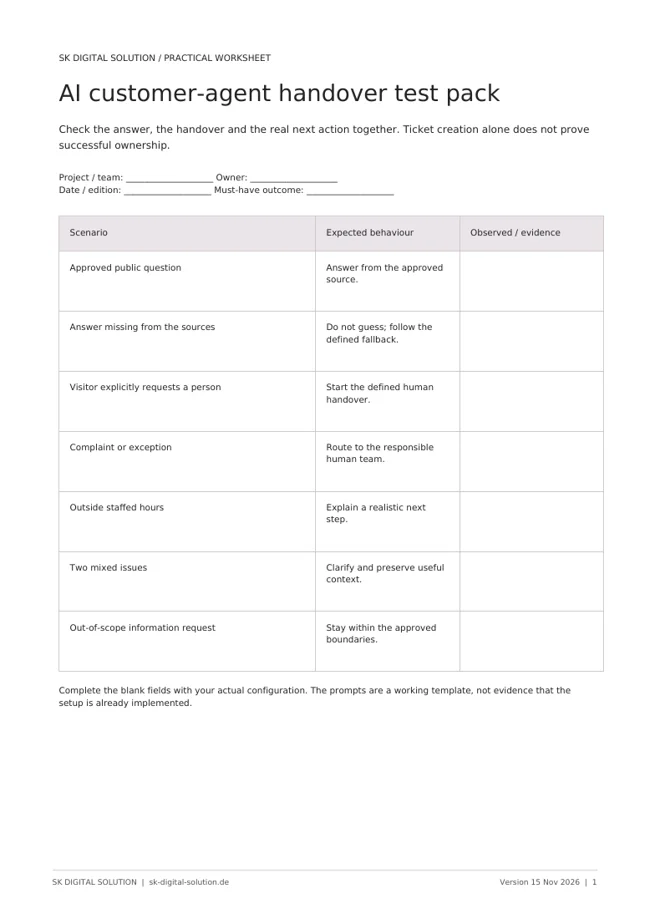
A good evaluation includes straightforward questions, ambiguity, conflicting information and explicit requests for a person. Use a repeatable test set so changes in knowledge or instructions can be reviewed against the same scenarios.
- A public question with a clear approved answer.
- A question whose answer is absent from the sources.
- A request that mixes two unrelated issues.
- A complaint or exception requiring human judgement.
- A visitor who asks directly for a person.
- A transfer outside staffed hours.
- An attempt to obtain information outside the agent\'s scope.
Record what the agent said, whether a transfer occurred and who actually received the request. Review factual accuracy and the customer's next step together. A technically correct answer can still be unhelpful if it leaves the person unsure how to proceed.
Monitor outcomes after deployment
Review unresolved conversations, repeated questions and failed transfers. Use them to improve the source material or the service process, not only the prompt. If visitors repeatedly ask about an unclear offering, the website itself may need clearer information.
Keep a named owner for knowledge and another for technical operation where those responsibilities differ. Establish a way to pause or limit the agent if an important source becomes inaccurate. Changes to the service team should also trigger a routing review.
AI can help businesses improve messy information and inefficient processes. That does not remove the need to define the intended outcome and verify its work. Good structure makes the improvement safer to scale and easier to maintain.
Frequently asked questions
Should the agent always answer before offering a person? No. If the visitor explicitly requests human support or the situation falls outside the approved scope, forcing another AI exchange can make the experience worse.
Can a transfer be considered successful when a ticket is created? Ticket creation is evidence of one technical step. Also verify assignment, context and the next action expected from the team.
What should we measure? Combine factual-answer review, unresolved requests, handover quality and relevant service outcomes. Do not optimise solely for fewer transfers if that makes customers struggle to get help.
SK Digital Solution connects AI assistants with the website, CRM and real service responsibilities. Discuss your customer-agent rollout.
HubSpot handoff documentation checked on 15 November 2026. This article proposes an implementation and evaluation approach; it does not claim a measured deflection rate or guaranteed service improvement.