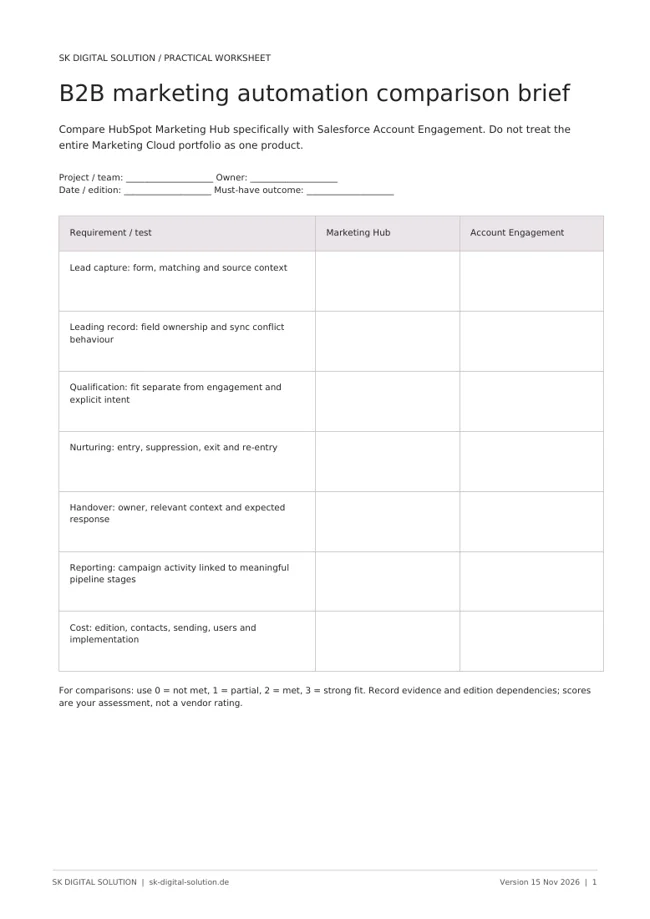

HubSpot Marketing Hub vs. Salesforce Account Engagement

HubSpot Marketing Hub and Salesforce Account Engagement are relevant options for B2B marketing automation. Compare how each would connect lead capture, qualification, nurturing and sales handover in your business. Do not treat every product carrying the Salesforce Marketing Cloud name as the same alternative.
Account Engagement, formerly Pardot, is one Salesforce marketing product. Salesforce also documents Marketing Cloud Engagement and Marketing Cloud Next as distinct offerings. Its product-identification guide explains their different tools and data structures. A proposal should name the product and edition precisely before anyone compares features or prices.
Define the journey you need to automate
Start with one genuine acquisition route: a visitor reads an article, requests a resource, engages with follow-up content and later asks for a conversation. Identify what marketing must know at each stage and what sales needs when it takes over.
Keep fit and behaviour separate. A relevant company with little engagement needs a different next step from an active reader outside your target market. A form submission is a signal, not automatically evidence of buying intent.
HubSpot Marketing Hub describes marketing automation within the HubSpot platform. Account Engagement documentation covers forms, prospect qualification and nurturing connected with Salesforce. Evaluate those capabilities against your journey rather than comparing vendor terminology.
Decide where the customer record lives
If marketing, sales and service already operate in HubSpot, assess the value of using their shared records and agreed lifecycle definitions. If Salesforce is the established sales system, assess Account Engagement's fit alongside that architecture and the responsibilities of your Salesforce administrators.
Neither starting point eliminates data design. Define which system owns company information, lifecycle status, owner assignment and communication preferences. Where platforms exchange data, document the direction, matching rule and conflict behaviour for every important field.
A useful test is a contact who requests a demo while already enrolled in a nurturing programme. Can the system recognise the existing person, route the request, stop inappropriate follow-ups and show sales the relevant activity? That is a more meaningful test than whether a platform can send an automated email.
Evaluate nurturing beyond the workflow canvas
A visual journey is only the surface of marketing automation. Your evaluation should include entry rules, suppression, exit conditions, re-entry and what happens when a person engages with several topics.
For example, a contact interested in both CRM migration and website integration should not receive conflicting introductions from unrelated programmes. Establish a priority rule and a clear next action. Keep existing customers, active opportunities and people who should not receive the programme out of it through an explicit eligibility design.
Subscription and consent configuration must follow your approved communication framework. Technical ability to send an email is not evidence that a person is eligible for that message. Have your responsible privacy or legal adviser review the relevant requirements for the markets and communication types involved.
Compare cost using your actual database
Build a cost model around the proposed edition, user access, contacts, sending needs, additional products and implementation. Ask which contact categories drive billing and what happens when your database grows. Avoid relying on a headline price without knowing how the vendor counts usage.
Also budget for lifecycle design, field mapping, migration, templates, reporting and training. A platform purchase does not create the operational agreement between marketing and sales.
Use one shared acceptance checklist:
- A form creates or updates the correct record.
- Qualification uses agreed fit and engagement criteria.
- A sales-ready request reaches the right owner with context.
- An ineligible contact exits or is suppressed appropriately.
- Reporting connects campaign engagement with meaningful pipeline stages.
Test these outcomes with sample data in the intended editions. Record any connector, additional product or manual step needed to make them work.
Choose around your operating model
Evaluate Marketing Hub when a coherent HubSpot customer journey is a priority and the proposed configuration meets your marketing requirements. Evaluate Account Engagement when Salesforce is central to sales operations and its B2B marketing model fits the journey you need. Treat this as a practical shortlist, not a claim that one product is inherently easier or more powerful for every organisation.
The final decision should include who owns the system after implementation. Ask how a marketer changes a programme, how an administrator updates a field and how teams investigate a failed handover.
Frequently asked questions
Is Account Engagement the same as Pardot? Account Engagement is the product formerly called Pardot. Use current product and edition names in procurement documents while recognising the older search term.
Is this the same comparison as HubSpot versus all of Marketing Cloud? No. Salesforce has multiple marketing offerings. This article focuses on Account Engagement's B2B context rather than treating its broader portfolio as one product.
Should we copy our existing journeys into the new system? First review whether those journeys still reflect customer intent and sales responsibilities. A migration is an opportunity to remove conflicting rules, not just rebuild them.
SK Digital Solution helps turn lead-generation activity into connected qualification and handover processes. Discuss your marketing-to-sales journey before selecting the platform.
Sources checked on 15 November 2026. Product names and packaging can change; confirm the current scope with both vendors before purchase.