
HubSpot Service Hub vs. Salesforce Service Cloud: A Practical Guide
HubSpot Service Hub and Salesforce Service Cloud both support customer-service operations, but a useful comparison must follow a request from first contact to resolution. Evaluate routing, customer context, escalation and follow-up together. A help desk is only effective when a real person or team remains responsible for each unresolved issue.
HubSpot is worth evaluating when service needs to work closely with an existing HubSpot marketing and sales setup. Salesforce is worth evaluating when a Salesforce environment or a more specialised service operating model already defines how work gets done. These starting points need validation; neither product is automatically right for every growing or enterprise business.
Start with the service process, not the inbox
Map your most common requests: a pre-sales question, a product issue, a complaint and a request requiring a specialist. Establish what each one needs before someone can respond. Sometimes the missing piece is order context; sometimes it is simply an agreed owner.
Define the difference between a conversation and a case or ticket. Several messages can belong to one unresolved issue, and one customer can have several issues at once. Your reporting needs to reflect work that is still open, not just messages that received an answer.
HubSpot Service Hub describes ticketing, help desk and knowledge capabilities across its product tiers. Salesforce's case-management guidance covers assignment, escalation, routing and knowledge. Verify the required edition for the exact combination you need.
Test routing with real exceptions
A routing rule should do more than forward a message. It should determine who owns the issue, what happens when that person is unavailable and how the customer will receive an update. Test an unrecognised language, an account without an owner and a request arriving outside working hours.
A practical evaluation scenario is a customer with an open sales opportunity who reports a support problem. Can the service team see the relevant context without exposing unrelated information? Can sales see that there is an unresolved issue without becoming responsible for support?
These questions reveal the relationship between permissions, customer records and handover. Do not assume sharing a CRM automatically produces a coherent service process. The records and responsibilities must still be designed.
Evaluate knowledge and AI as operational systems
A knowledge base needs an owner, a review cycle and clear rules for internal versus public information. Search quality will not compensate for contradictory policies. Test the same customer question against old and current content and check how the team handles the conflict.
If an AI agent is part of the proposal, evaluate it separately from ordinary ticketing. Ask what sources it can use, what actions it may take and when it must transfer a conversation. Confirm subscription, channel, usage and credit requirements in the current offer rather than assuming an AI feature is included without limits.
Human handover is a service outcome, not a chatbot setting. A transfer should deliver useful context to an available team, preserve the question and provide a realistic next step. An agent that stops answering but leaves nobody accountable has not completed the handover.
Build a service-specific comparison
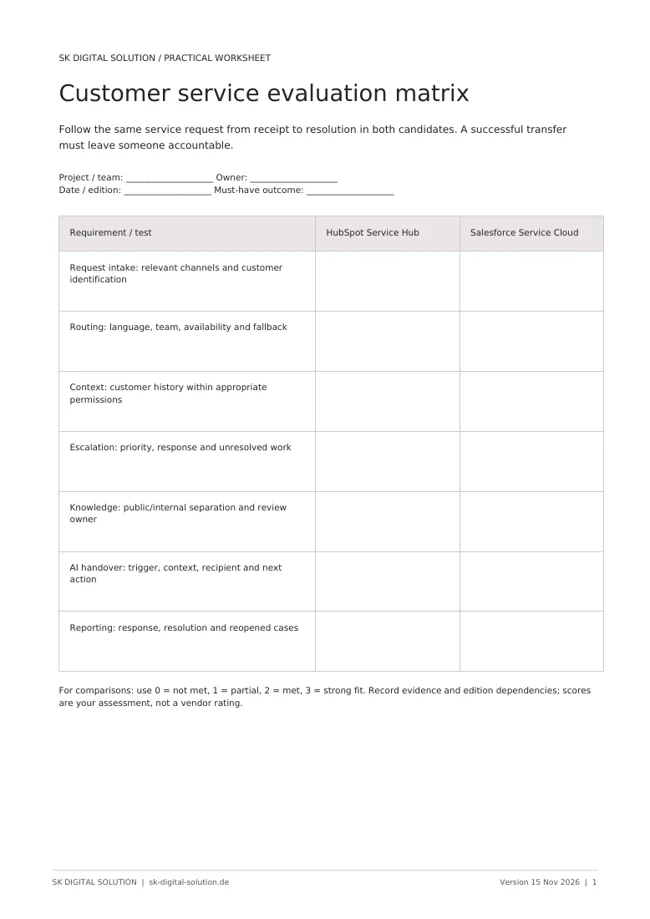
Use the same scenarios in both platforms and capture dependencies in writing. The following questions make a better scorecard than a list of product labels.
- Can each request be assigned to an accountable team with an effective fallback?
- Can agents find the customer context they need within their permissions?
- Can your proposed edition support the required response and escalation rules?
- Can the team maintain public knowledge without exposing internal material?
- Can managers distinguish first response, resolution and reopened work?
Agree how each metric is calculated before comparing dashboards. A system that closes tickets automatically can appear faster without delivering a better customer experience. Add qualitative review of real conversations to the numerical reporting.
Make the decision around ownership
Service Hub can be a strong fit when the evaluated configuration creates a manageable service process around the customer record your teams already use. Service Cloud can be a strong fit when its evaluated configuration supports the required service complexity and aligns with your Salesforce architecture. The evidence should come from the same test cases and clearly scoped proposals.
Include the full cost of implementation, migration, training, telephony or other channels, knowledge maintenance and ongoing administration. A purchase that leaves these responsibilities unfunded is incomplete even if the subscription looks attractive.
Frequently asked questions
Is a shared inbox enough instead of a help desk? It may be enough for a simple process. Once ownership, priorities and unresolved cases become difficult to track, evaluate structured ticketing rather than adding more inbox folders.
Does AI remove the need for a service team? No. An AI agent can support defined tasks, but exceptions, complaints and uncertain answers still need a deliberate human process.
Can we choose based on our existing sales CRM? That is an important factor, not the only one. Test the service journey, integration requirements and permissions before assuming the same vendor is automatically the best choice.
Read our published HubSpot customer-agent project for a related implementation context. SK Digital Solution connects customer-facing experiences with CRM processes and clear team responsibilities. Talk to us about your service setup.
Sources checked on 15 November 2026. Recommendations are an editorial implementation framework, not measured comparative performance claims.