%201.svg)
Why your website is invisible on Google – and how to fix it
Why Google Visibility Starts with Indexing
A website can be fully live and still remain almost invisible in Google Search.
Before a page can rank, Google first needs to discover it, crawl it, understand its content, and add it to the search index. This makes technical indexability one of the most important foundations of SEO.
Especially after a website relaunch, domain migration, CMS change, or major content update, pages are not always indexed automatically or immediately. Even high-quality content cannot generate organic traffic if search engines cannot access or process it correctly.
That is why technical SEO should always start with a basic question: Can Google reliably find and index the pages that matter?
A simple first check is a Google search using:
site:yourdomain.com
This gives a quick indication of which pages from a domain are already visible in Google’s index.
Common Technical Reasons Why Pages Are Not Indexed
There are several technical reasons why important pages may not appear in Google Search.
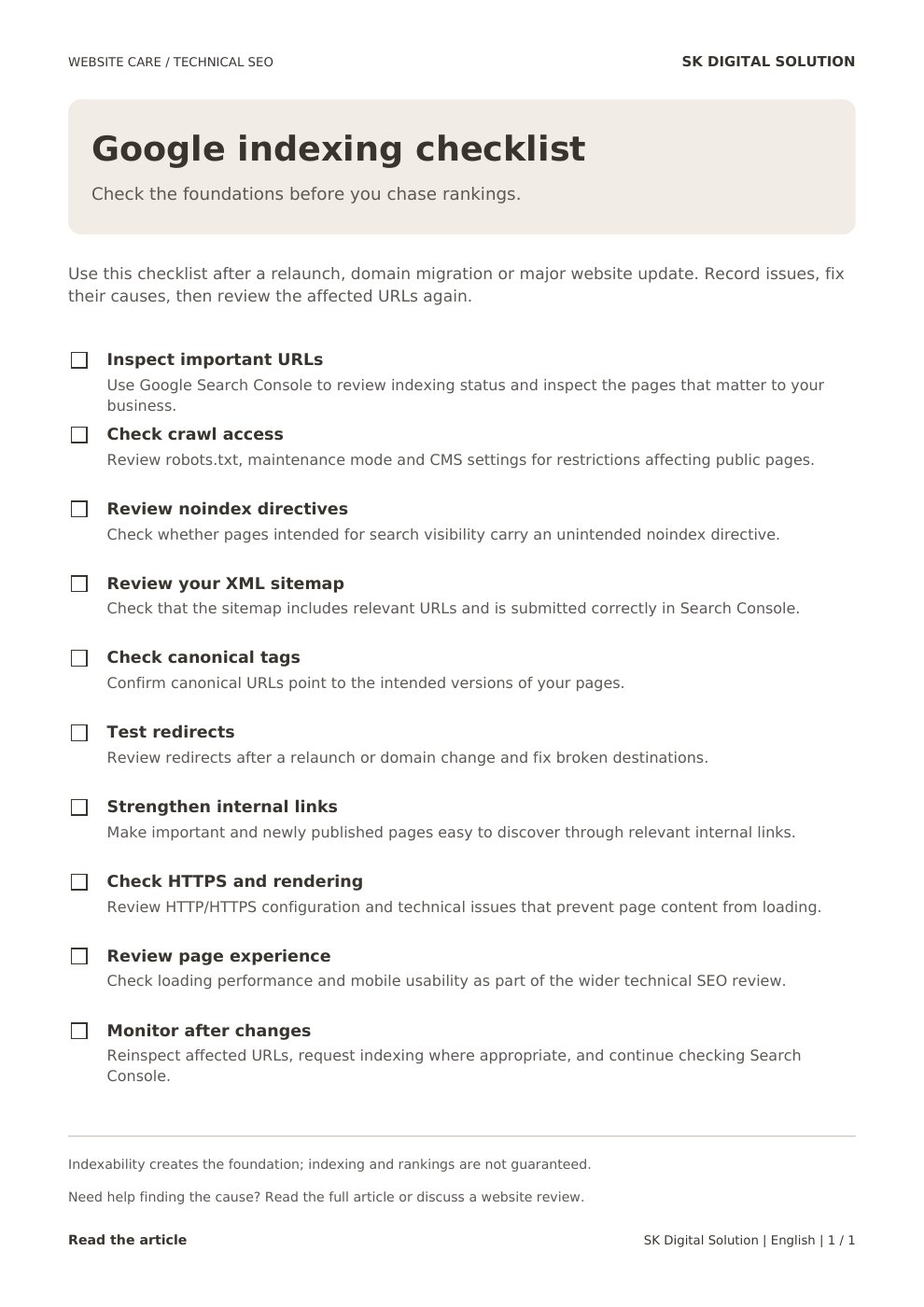
Common issues include:
- missing or incorrectly submitted XML sitemaps
- robots.txt rules blocking relevant pages or directories
- noindex directives preventing pages from entering the search index
- maintenance mode or CMS settings restricting search-engine access
- incorrect canonical tags
- broken redirects after a relaunch or domain migration
- weak internal linking that makes new pages difficult for crawlers to discover
- HTTP or HTTPS configuration issues
- slow loading times or technical rendering problems
A professional SEO review therefore goes beyond checking whether the website is online.
The crawlability, indexability, URL structure, redirects, internal linking, sitemap configuration, and technical page settings should all be reviewed together.
Tools such as Google Search Console help identify indexing problems, inspect individual URLs, monitor sitemap status, and request indexing for new or significantly updated pages.
Building a Strong Technical SEO Foundation
Successful SEO does not start with keywords or rankings. It starts with technical accessibility.
A solid indexing setup should include a complete XML sitemap, correct robots.txt configuration, secure HTTPS delivery, clean URL structures, mobile optimization, strong page performance, and clear internal linking.
After a relaunch or larger website update, indexing should also be actively monitored rather than treated as a one-time task.
Relevant pages should regularly be checked for:
- crawlability
- indexability
- correct canonicalization
- sitemap inclusion
- Google Search Console status
- internal linking
- page performance
- mobile usability
This creates the technical foundation required for content to rank, attract qualified organic traffic, and support long-term lead generation.
In short: before a website can build visibility, traffic, and conversions through SEO, search engines first need to access and index it correctly.
.svg)
%201.svg)