
HubSpot Lead Scoring: Separate Fit, Engagement and Buying Intent

HubSpot lead scoring should help a team decide what to do next, not simply produce a number. Separate whether a contact fits your target customer profile from how they engage with your business. Then define which evidence justifies nurturing, human review or a sales handover.
A person can read several articles without needing your service. Another person can submit a specific implementation request with very little prior tracked activity. A useful scoring model recognises that behaviour is context, not a substitute for the meaning of the request.
Start with an agreed qualification decision
Ask marketing and sales to describe a lead they would genuinely prioritise. Identify the characteristics that matter and the evidence of a relevant need. If the teams disagree, building a score will encode that disagreement rather than resolve it.
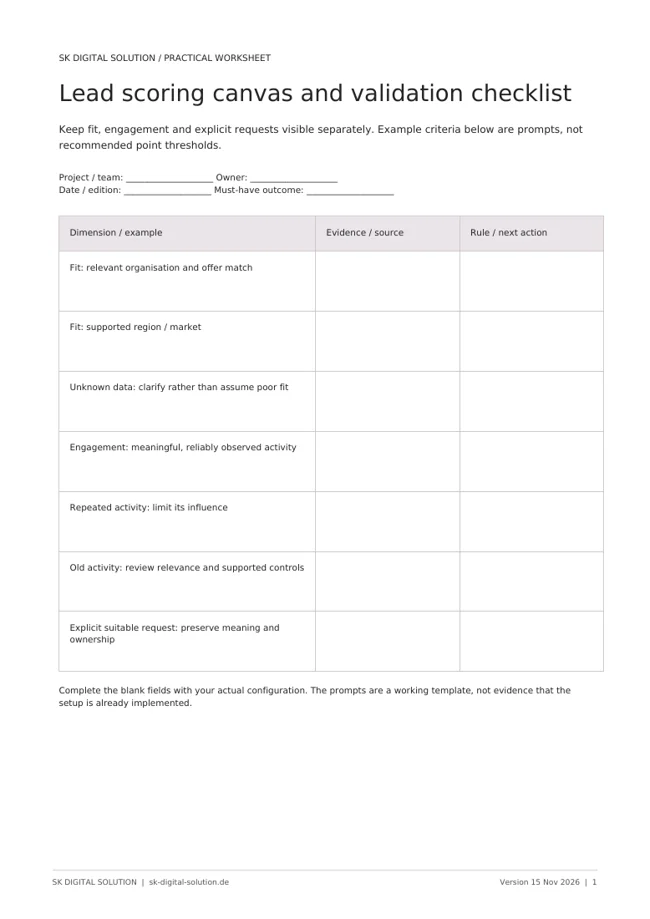
Define fit using information such as the organisation's relevance, supported region or relationship to your offer. Define engagement through actions that plausibly indicate interest. Keep explicit buying signals, such as a suitable consultation request, visible rather than burying them beneath a general activity total.
HubSpot's lead-scoring documentation distinguishes fit criteria based on properties from engagement criteria based on events, with available score types depending on the product and object. Check your actual account's capabilities before designing a model that requires a different subscription.
Use a simple fit-and-engagement matrix
A practical starting framework has four situations. A strong-fit, engaged contact may deserve sales review. A strong-fit contact with limited activity may need useful education. A weak-fit, active reader should not automatically become a sales priority. A weak-fit, inactive record usually does not need an intensive follow-up programme.
This matrix is a recommended design approach, not a universal HubSpot default. Translate it into your business definitions and test it against real records. Do not copy another organisation's point thresholds without understanding its customer journey.
Also decide what “unknown” means. Missing company size is not necessarily a bad fit. It may indicate that the team needs more information before making a decision. Treating missing data as a definite negative can exclude relevant opportunities.
Prevent repeated activity from dominating the score
Repeated low-value actions should not outweigh a meaningful request. Group related activities and consider limits so a contact cannot become your highest-priority lead simply by opening many similar messages.
Review which signals your tracking can reliably observe. An email open is not equivalent to a deliberate request, and a missing tracked visit does not prove a person has no interest. Use behaviour as one input alongside explicit information and sales feedback.
Define how old activity should influence the decision. If historical engagement no longer describes current intent, use the supported scoring or process controls to reduce its importance. Review the available decay, exclusion and reset behaviour in your subscription before relying on it.
Connect the score to an accountable handover
A high score without an owner creates no operational value. Define who reviews the lead, what information they receive, when a follow-up is expected and what happens if the lead is not ready.
Include the reason for prioritisation. “Requested a CRM migration conversation and matches our target segment” is more useful than “Score: 78.” Keep the relevant request, company context and previous interactions visible in the record.
Create a feedback loop. Sales should be able to distinguish accepted, not-ready and unsuitable leads with a meaningful reason. Marketing can then improve the model without guessing whether a low meeting rate means poor targeting or slow follow-up.
Use a small validation set before turning on any consequential routing:
- Relevant enquiries that became genuine opportunities.
- Active readers who were not suitable buyers.
- Existing customers and open opportunities.
- Contacts with incomplete information.
- Records whose activity is old.
- Explicit requests with little tracked history.
Look for false positives and false negatives rather than merely whether the model assigns points.
Review outcomes, not just score distribution
A healthy score distribution is useful, but it is not the final business outcome. Review whether prioritised leads receive timely attention and whether the handover produces appropriate conversations. Investigate changes in traffic mix or campaigns before adjusting thresholds.
Document the score owner, criteria, review date and the actions associated with each qualification state. Your sales team should be able to explain why a record received attention without reading a long workflow.
Frequently asked questions
What score should trigger an MQL? There is no universal threshold. Define the qualification standard, test representative records and then set a threshold that supports that decision.
Does a high engagement score prove buying intent? No. It indicates activity under your rules. Fit, the meaning of the interaction and explicit requests still matter.
Can we do useful qualification without advanced scoring features? Yes. Clear properties, explicit request types and a review process can be valuable before introducing a more sophisticated model.
Our published HubSpot data-standardisation project shows why consistent classification matters before downstream automation. SK Digital Solution helps connect qualification with nurturing and sales ownership. Review your lead process with us.
HubSpot scoring documentation checked on 15 November 2026. Examples are illustrative recommendations, not reported customer results or universal scoring rules.